A year and two months ago, on the eve of my journey to Georgia, I was somewhat resigned to the fact that my experience there would be my last opportunity to live abroad. Being a ducks-in-a-row kind of gal, I was quite certain of my life trajectory until July of 2014, and after that, I had a fairly concrete plan of what would happen next. When I returned from Georgia, I would be with Citizen Schools in New Bedford for two years, and during that time, I expected to move in with my boyfriend and his family, to get engaged, and to marry. After completing my AmeriCorps service, I would go to graduate school or go back for a second undergraduate degree, graduate, and begin my career.
Well, that's not exactly how things turned out. I did get engaged in July and married in November, but not to that boyfriend. I was lucky enough to meet my other half and life partner, Patrick, in Georgia. To clarify for those of you that are doing the math, yes, I was engaged to a man that I had known for four months, and we married after knowing each other for ten months. Honestly, I couldn't be happier or feel better about our decision, but I could have never forseen this.
Because I am married to Patrick, I know that I will live abroad again. Our interest in different cultures and languages is what got us out of North America and brought us together in the first place. So, Georgia wasn't my last hurrah, but rather the beginning of a new, more adventurous chapter in my life. Due to some changes at work, which are still under wraps, I will be leaving Citizen Schools on positive terms at the end of June. This means that instead of waiting until 2014 to go abroad, Patrick and I will be teaching English abroad, hopefully in Russia, this fall. That's about five months away.
These days, I'm counting down to the end of a few parts of my life and the beginning of others.
6 program days until the on-campus WOW!
8 program days until the Mock Trials WOW!
19 program days remaining
9 weeks of work remaining (one of which is a vacation week)
9 weeks until Patrick and I are together and ideally done with being in a long-distance marriage
12 weeks until our CELTA certification class begins at Teaching House Boston
Truthfully, as soon as the after-school program is over, I know I'll feel alive again. Until then, I'll be counting down the days and hours until the daily grind is over and real life begins again.
Sunday, April 28, 2013

Monday, May 28, 2012
A Georgian Birthnapping
Last Monday was my twenty-third birthday, and I can honestly say that it was the most memorable one I've ever had. In the morning my host mother, host grandfather, and I drove to a coworker's house to pick up my cake and bring it to school. It was by far the fanciest cake I've ever had. Throughout the day teachers and children were kept wishing me "Happy birthday!" and giving me flowers. After my last lesson, a friend, the TLG volunteer in Sighnaghi, came to my school, and we meandered outside in search of our friends from the hostel. I felt a little uneasy because I got the vibe that they had organized birthday plans for me, but I couldn't bail on my coworkers because they were throwing a supra for me. To me, it seemed like the obvious solution was to invite them to the supra and then to do whatever they had planned.
 As I turned back toward the school, a large blue sack was thrown over my head, and I found myself being lifted into the back of a car. I was held down for a bit, and when I was eventually permitted to sit up and remove the sack, I realized that other than Sighnaghi's volunteer, I didn't actually know my kidnappers: a Georgian, a Norwegian, and a Russian. While we were getting acquainted, one of my co-teachers called me to make sure that I was returning to the school for my birthday supra. It was sort of a bummer that the supra threw a wrench in my friends' plan, but it would have been really rude to skip it.
 After the supra I got into my friends' car, and even though their attempted kidnapping was somewhat foiled, they refused to tell me where we were going. They did, however, surprise me with a large bag of chocolate vaplebi. FYI, vaplebi, whose singular form is vapli, are wafers layered with cream, and I'm addicted to them. We met up with their kidnapper friends, who had gone ahead of us, in Dedoplis Tskaro. Unfortunately, they had to return their rental car in Tbilisi by 6pm, so they had to leave, but my friends from the hostel and my two local TLG friends drove on toward the unknown destination. Along the way, they decided to blindfold me, and when the car finally stopped and they let me put my glasses back on, I saw this.
 Its name is Khornabuji Castle, and honestly, I know very little about it, so you're probably better off Googling it. Anyway, we climbed up to the top, where we enjoyed some champagne, vaplebi, and the great view. The climb was pretty treacherous because there weren't any safety rails to keep you from falling off the edge and into the abyss if you tripped. I think this is pretty typical for most sites in Georgia.
Anyway, we wrapped up the evening with Sheepshead, a fantastic card game from Wisconsin, and dinner. On my way back home, the other TLG volunteer in my village and I hitched a ride with two random Georgian guys, who treated us to beer. All in all, it was an incredible birthday, and I'm never going to forget it.


Anyway, we wrapped up the evening with Sheepshead, a fantastic card game from Wisconsin, and dinner. On my way back home, the other TLG volunteer in my village and I hitched a ride with two random Georgian guys, who treated us to beer. All in all, it was an incredible birthday, and I'm never going to forget it.
Saturday, May 19, 2012
Day of Victory over Fascism
Ten days ago, I finally got out of the village after having stayed there for three and a half weeks. The only reason I was able to stay in Nukriani for so long without getting too stir-crazy is Hostel Tura. It's about a 45-minute walk from my house in the village, and for me, it's pretty much a bastion of awesomeness and of support. Needless to say, I spend a fair amount of time there, and I'm really lucky to have been conveniently placed so close to the hostel.
Anyway, May 9 is a Georgian public holiday: the Day of Victory over Fascism. It marks the surrender of Nazi Germany to the Soviet Union, in other words, the end of World War II. In the West we commemorate Victory in Europe Day on May 8, but due to time zone differences, I think, the former Soviet states celebrate it on May 9 instead. Now, I honestly have no idea what, if anything, Georgians do on May 9. It was, after all, a Soviet victory, and the Georgians with whom I've spoken about Russia abhor its government, understandably. At the same time, Joseph Stalin was ethnically a Georgian.
 I celebrated May 9 by going to the village of Duisi in the Pankisi Gorge to see a derby. Pankisi is a valley in northeastern Kakheti that borders Chechnya. It is inhabited by Kists, and since I know next to nothing about them, it's probably best that you skim the Wikipedia article. I can tell you that they speak Kist, a dialect of Chechen, and Georgian and that they're Muslims. Jihadism has at least touched Duisi a little. There was a shop selling calendars with jihadist literature in Russian, and one of the little boys said in Georgian,"Chven vart mujahidebi, insha'Allah," or "We are the mujahideen, God willing." I also heard some Allahu Akbars when the children shot their toy guns.
I think the highlight of the holiday for the Kist children was shooting foreigners with plastic BBs. There was a group of 33 Westerners there, and we apparently made great targets. Fortunately, some of the foreigners had gone the year before, so they knew to buy guns ahead of time to shoot back. I only got shot ten or so times, but it was certainly annoying. The derby itself turned out to be a bit of a bust, but all in all, I was just grateful to be in good company and to be out of the village.

Anyway, May 9 is a Georgian public holiday: the Day of Victory over Fascism. It marks the surrender of Nazi Germany to the Soviet Union, in other words, the end of World War II. In the West we commemorate Victory in Europe Day on May 8, but due to time zone differences, I think, the former Soviet states celebrate it on May 9 instead. Now, I honestly have no idea what, if anything, Georgians do on May 9. It was, after all, a Soviet victory, and the Georgians with whom I've spoken about Russia abhor its government, understandably. At the same time, Joseph Stalin was ethnically a Georgian.


Saturday, May 5, 2012
A Georgian Funeral
Last Saturday, I went to a Georgian funeral, and it was definitely a unique experience. The father-in-law of a teacher at my school had passed away, and all the staff at the school was invited to the funeral. According to my main co-teacher, when a Georgian dies, the body is kept at home for five days, and during that time, the undertaker visits and prepares the body for burial. On the fifth day, the funeral is held.
That afternoon, I arrived at my coworker's house, which is two houses down from my host family's, and sat with the other teachers from school on the porch. After about an hour, a little procession of family members filed down the stairs. A few young men came down carrying flowers, and they were followed by a large group of women--young and old alike. Some of the young women were openly sobbing, but their grief paled in comparison to that of the widow, who was hoarsely wailing "Vaime! Vaime!" Next, a group of men brought down the lid to the coffin, and another group carried the coffin holding the body of the man who had died. They propped up the coffin on two chairs in the yard, and all the guests awkwardly stared at the family as they grieved.
A few minutes passed before the men picked up the coffin and presumably loaded it into a van. The immediate family members filed out of the yard after them, followed by the female guests, and then by the male guests. We walked along the road to a nearby cemetery, and at this point, I realized how many people were actually there--some 200 according to my main co-teacher--and more people were still arriving. On the way to the cemetery, my main co-teacher pointed out the flowers on the road. Apparently one of their traditions is to leave a trail of flowers from the home to the cemetery. She also explained that the funeral would be followed by a ქელეხი (kelekhi), or funeral banquet. These banquets are incredibly expensive because the family must kill a cow and feed a couple hundred guests.
We were at the cemetery long enough for the body to be buried, and then everyone returned to the house for the feast. There was a massive tent set up in the yard with two rows of tables and four rows of benches underneath it. Plates of food were literally piled on the tables. Every two or three place settings there were the following foods and drinks: bread, nazuki, a bulb of garlic, cheese, mushrooms, greens (onions, radishes, cucumbers, tomatoes, and some herbs), eggplants with walnuts, fish prepared in two different ways, chicken, jonjoli, potatoes, beets, a spinach spread, olives, mineral water, soda, and wine. In addition to all of this, they brought around huge platters of beans, beef, wheat with honey, fried potatoes with beef, mashed potatoes with mutton, and porridge with rice and mutton. It was by far the most incredible feast that I've ever seen in my entire life.
That afternoon, I arrived at my coworker's house, which is two houses down from my host family's, and sat with the other teachers from school on the porch. After about an hour, a little procession of family members filed down the stairs. A few young men came down carrying flowers, and they were followed by a large group of women--young and old alike. Some of the young women were openly sobbing, but their grief paled in comparison to that of the widow, who was hoarsely wailing "Vaime! Vaime!" Next, a group of men brought down the lid to the coffin, and another group carried the coffin holding the body of the man who had died. They propped up the coffin on two chairs in the yard, and all the guests awkwardly stared at the family as they grieved.
A few minutes passed before the men picked up the coffin and presumably loaded it into a van. The immediate family members filed out of the yard after them, followed by the female guests, and then by the male guests. We walked along the road to a nearby cemetery, and at this point, I realized how many people were actually there--some 200 according to my main co-teacher--and more people were still arriving. On the way to the cemetery, my main co-teacher pointed out the flowers on the road. Apparently one of their traditions is to leave a trail of flowers from the home to the cemetery. She also explained that the funeral would be followed by a ქელეხი (kelekhi), or funeral banquet. These banquets are incredibly expensive because the family must kill a cow and feed a couple hundred guests.
We were at the cemetery long enough for the body to be buried, and then everyone returned to the house for the feast. There was a massive tent set up in the yard with two rows of tables and four rows of benches underneath it. Plates of food were literally piled on the tables. Every two or three place settings there were the following foods and drinks: bread, nazuki, a bulb of garlic, cheese, mushrooms, greens (onions, radishes, cucumbers, tomatoes, and some herbs), eggplants with walnuts, fish prepared in two different ways, chicken, jonjoli, potatoes, beets, a spinach spread, olives, mineral water, soda, and wine. In addition to all of this, they brought around huge platters of beans, beef, wheat with honey, fried potatoes with beef, mashed potatoes with mutton, and porridge with rice and mutton. It was by far the most incredible feast that I've ever seen in my entire life.
Wednesday, April 18, 2012
Easter Feast
It was pretty important to me that I spend Easter with my host family, especially since I hadn't experienced a proper Georgian feast. Other volunteers said that their families had thrown supras for them, but my family had yet to do so for me. I think the reasons were that none of my family members are big drinkers and that they may not be able to afford one.
On Sunday afternoon I went for a nice long walk with my host sister and her cousin. At the top of a nearby hill there are two abandoned, yellow, cement buildings that overlook Nukriani. They were originally used to house summer campers, but in 2008 Abkhazian refugees were temporarily settled there. We checked out the buildings and ventured into the coniferous forest beyond.
 When we returned from the walk, the table was set with all sorts of good things. For meat there was chicken and uncooked ham. For vegetables there were beets cooked in t'kemali, shredded carrots mixed with mayo, pickled jonjoli, and potato salad. The main part of the meal was t'olma, a meat and rice mixture wrapped in cabbage, and p'ask'a, Georgian Easter bread, which is surprisingly like Portuguese sweet bread. There were three kinds of p'ask'a: regular, with jam, and with walnuts and sugar. The one with jam was the best in my opinion. There were also red eggs, tonis puri, suluguni cheese, and khachapuri. For beverages there was Pepsi, wine, and cornel juice. I started off with wine, but when I noticed that none of the other women were drinking, I switched over to the juice, which was much tastier.
The only traditions worth noting were that they lit a substance and let the smoke waft over the table and they burned a candle in the p'ask'a. Also, the seating arrangements weren't cool. All of the men sat at a slightly higher table and the women sat at a lower adjacent table. Gender issues much?
 The conversation at the table was interesting. I could tell that my host mother's sister was talking about politics, and I heard her say that she didn't like the president, and my host mother was definitely surprised to hear her sister say that. Realistically, my host aunt is far more informed than my host mother because the aunt lives in Tbilisi and has access to more information. Out in the villages, there are very few TV channels, and they definitely seem to glorify Georgia. It's a little over the top. Also, a few weeks ago, my Georgian friend from Tbilisi mentioned that the media is censored, so unless you have satellite TV and can watch Maestro, an opposition channel, then you're sort of in the dark. I found it sort of silly that my host mother then turned to me for my opinion. I mean, I don't know a whole lot about Georgian politics, and I feel pretty nonchalant about it.
 The other topic of conversation that I somewhat picked up on was about the Svan and Mingrelian languages. Once I realized what they were talking about, I had my host sister translate for me. Apparently, the adults were saying that they thought it was wrong for Georgians to speak these languages. Because of Georgia's history, I understand how important unity is, and a common language can certainly help people identify with each other. At the same time, Svan and Mingrelian are dying languages, and I'm really into languages, so I didn't offer an opinion.
On Sunday afternoon I went for a nice long walk with my host sister and her cousin. At the top of a nearby hill there are two abandoned, yellow, cement buildings that overlook Nukriani. They were originally used to house summer campers, but in 2008 Abkhazian refugees were temporarily settled there. We checked out the buildings and ventured into the coniferous forest beyond.

The only traditions worth noting were that they lit a substance and let the smoke waft over the table and they burned a candle in the p'ask'a. Also, the seating arrangements weren't cool. All of the men sat at a slightly higher table and the women sat at a lower adjacent table. Gender issues much?


Monday, April 16, 2012
ქრისტე აღსდგა
Yesterday was Easter for Georgia's Orthodox Christians. The overwhelming majority of Georgians (84%) are Orthodox Christians; however, there are some Georgian Muslims (10%) and even some Catholics (less than 1%). Interestingly enough, there are actually Jehovah's Witnesses in Sighnaghi. The title of my post is pronounced krist'e aghsdga, and it literally means Christ has risen. This is what Georgians say instead of Happy Easter. The appropriate response is ჭეშმარიტად აღსდგა or ch'eshmarit'ad aghsdga, which means truly he has risen.
My Georgian Easter experience began on Saturday evening around 9:30pm. Grandpa drove me, my host sister, her cousin, a neighbor, and her son to Saint Nino's Monastery in Bodbe. The monastery is only a 45-minute walk from my host family's house, but I hadn't gotten around to going before then. It's very beautiful, especially inside. There are so many interesting icons and frescoes. Unfortunately, taking photos inside the church is not allowed, so you'll have travel to Georgia to see it for yourself.
 The service itself was certainly different, but before I get to that, I have some random observations to share. In Georgian Orthodox churches, women must cover their heads and wearing pants is frowned upon. Georgians cross themselves top, bottom, right, and left instead of left and then right. They light candles in front of religious icons, and they kiss them. I also saw some women prostrating themselves in front of icons and touching their heads to the floor.
Things finally got going around 12:30am when a nun started chanting. With everyone packed into the little church, it was difficult to hear and see everything, but I could definitely smell body odor and beeswax candles. While the nun said her bit, a deacon (I think) started lighting candles, and then the priest started speaking. Every so often he would stop and the ladies in the choir would sing a few words and then he'd resume again. There was a little procession with a Bible and some icons, and everyone in the church filed outside afterwards and lit their beeswax candles. We circled the church twice, and then either the priest or the deacon rang the bells. After a bit we went back inside, and there was more of the same speaking and singing. The priest also swung a thurible around a bit.
At this point, my host sister and I left the church and sat outside with her cousin. Come to find out, her cousin couldn't enter the church because she had her period. I know the Bible says that makes women unclean, but come on, it's 2012. I was flabbergasted to say the least. When I got cold, I went back into the church, but I eventually went to the car and hung out with Grandpa so that I could sit and doze off around 2:00am. The service was finally over around 3:00am, and I now understand why none of the adults in the house wanted to go to church.
My Georgian Easter experience began on Saturday evening around 9:30pm. Grandpa drove me, my host sister, her cousin, a neighbor, and her son to Saint Nino's Monastery in Bodbe. The monastery is only a 45-minute walk from my host family's house, but I hadn't gotten around to going before then. It's very beautiful, especially inside. There are so many interesting icons and frescoes. Unfortunately, taking photos inside the church is not allowed, so you'll have travel to Georgia to see it for yourself.

Things finally got going around 12:30am when a nun started chanting. With everyone packed into the little church, it was difficult to hear and see everything, but I could definitely smell body odor and beeswax candles. While the nun said her bit, a deacon (I think) started lighting candles, and then the priest started speaking. Every so often he would stop and the ladies in the choir would sing a few words and then he'd resume again. There was a little procession with a Bible and some icons, and everyone in the church filed outside afterwards and lit their beeswax candles. We circled the church twice, and then either the priest or the deacon rang the bells. After a bit we went back inside, and there was more of the same speaking and singing. The priest also swung a thurible around a bit.
At this point, my host sister and I left the church and sat outside with her cousin. Come to find out, her cousin couldn't enter the church because she had her period. I know the Bible says that makes women unclean, but come on, it's 2012. I was flabbergasted to say the least. When I got cold, I went back into the church, but I eventually went to the car and hung out with Grandpa so that I could sit and doze off around 2:00am. The service was finally over around 3:00am, and I now understand why none of the adults in the house wanted to go to church.
Monday, April 9, 2012
Peace, Quiet, Solitude, and Personal Space
If you require all of the above to function, don't come to Georgia and live with a host family if you're not willing to be rude. Right now, I am the epitome of rudeness in Georgia, and I'm okay with that.
I was on the porch with my laptop; my host sister and her laptop, which the president of Georgia personally gave to her; my host mother; my host grandmother; and the devil child. (A couple of weeks ago my host family started boarding a six-year-old boy who happens to be the worst-behaved animal in the first grade.) I had been considering moving inside for a little while, and I finally decided to retreat to my room when a guest showed up with a toddler. (The toddler has been fussing and crying for awhile now, so it was good timing.) Anyway, I'm now sitting alone in my room with the door closed, and I just blew my nose rather loudly. I'm also not wearing house slippers. How rude!
Before coming to Georgia, I was aware that Georgians are people-persons and that alone time might be hard to come by. I feel like I've handled that part rather well. Using my host sister as a translator, I was able to explain that Americans often spend time by themselves, that I would be spending time alone, and that my host family shouldn't take it to mean that I don't like them. For example, I said that after dinner in the evening at my permanent home in the States, my mum watches TV downstairs and crochets, my dad either watches TV upstairs or plays darts in the garage, and I play on the computer in my room. When I spend time alone in Georgia, I try to go for walks because it's less awkward than sequestering myself in my room, but at the moment I need some quality time with my laptop and I've gotten more than enough sun and sweat the past three days. Unfortunately, since the addition of the little monster to my host family, I've barely been spending time with anyone, but I'm not going to torture myself to avoid being rude. I just try to make the little time I do spend with my host mother and host sister meaningful.
I also knew ahead of time that the concept of personal space was nonexistent in Georgian culture. I don't consider myself a touchy-feely individual, so this has certainly been a challenge. The first couple of weeks, all of the women were pinching my cheeks, touching my hair, chucking me under the chin, and my host sister and host mother even kissed my neck. These women were all complete and utter strangers, so I really disliked all of the physical affection even though I knew that they meant well. I liked the touching even less because in Georgia there is no health education, so Georgians don't understand how important it is to wash their hands and to not cough or breathe all over you if they're sick. I approached it by asking my main co-teacher, whose English is quite good, to explain that in America people don't touch each other as much and to ask everyone to stop touching me from the neck up. No one was offended. If anything, they were amused by this cultural difference, and I haven't really had any more issues. My host mother and sister are still quite touchy, but only if I go in for the hug first
What I didn't anticipate was how difficult it would be to get some peace and quiet. I correctly guessed that I would be in a village. How noisy could it be? Well, the roosters are pretty loud, but I've seen them in action. They sound the alarm when a hawk is in sight, so they're not totally useless. Actually, I really enjoy the chickens. They eat organic waste, which is awesome, although they aren't too fond of carrots and cabbage. I feed them my apple cores, and in return, they provide delicious eggs. Noise-wise, it's not the roosters that bother me. I've already established that the child is extremely loud, but it's not just him. My host sister randomly bursts into song. The TV is often on, and my host family keeps the volume turned up. Neighbors constantly swing by, and they talk excitedly about who knows what. Perhaps culturally, there is just a need to fill the silence with anything: music, speech, phone calls, television, etc.
I was on the porch with my laptop; my host sister and her laptop, which the president of Georgia personally gave to her; my host mother; my host grandmother; and the devil child. (A couple of weeks ago my host family started boarding a six-year-old boy who happens to be the worst-behaved animal in the first grade.) I had been considering moving inside for a little while, and I finally decided to retreat to my room when a guest showed up with a toddler. (The toddler has been fussing and crying for awhile now, so it was good timing.) Anyway, I'm now sitting alone in my room with the door closed, and I just blew my nose rather loudly. I'm also not wearing house slippers. How rude!
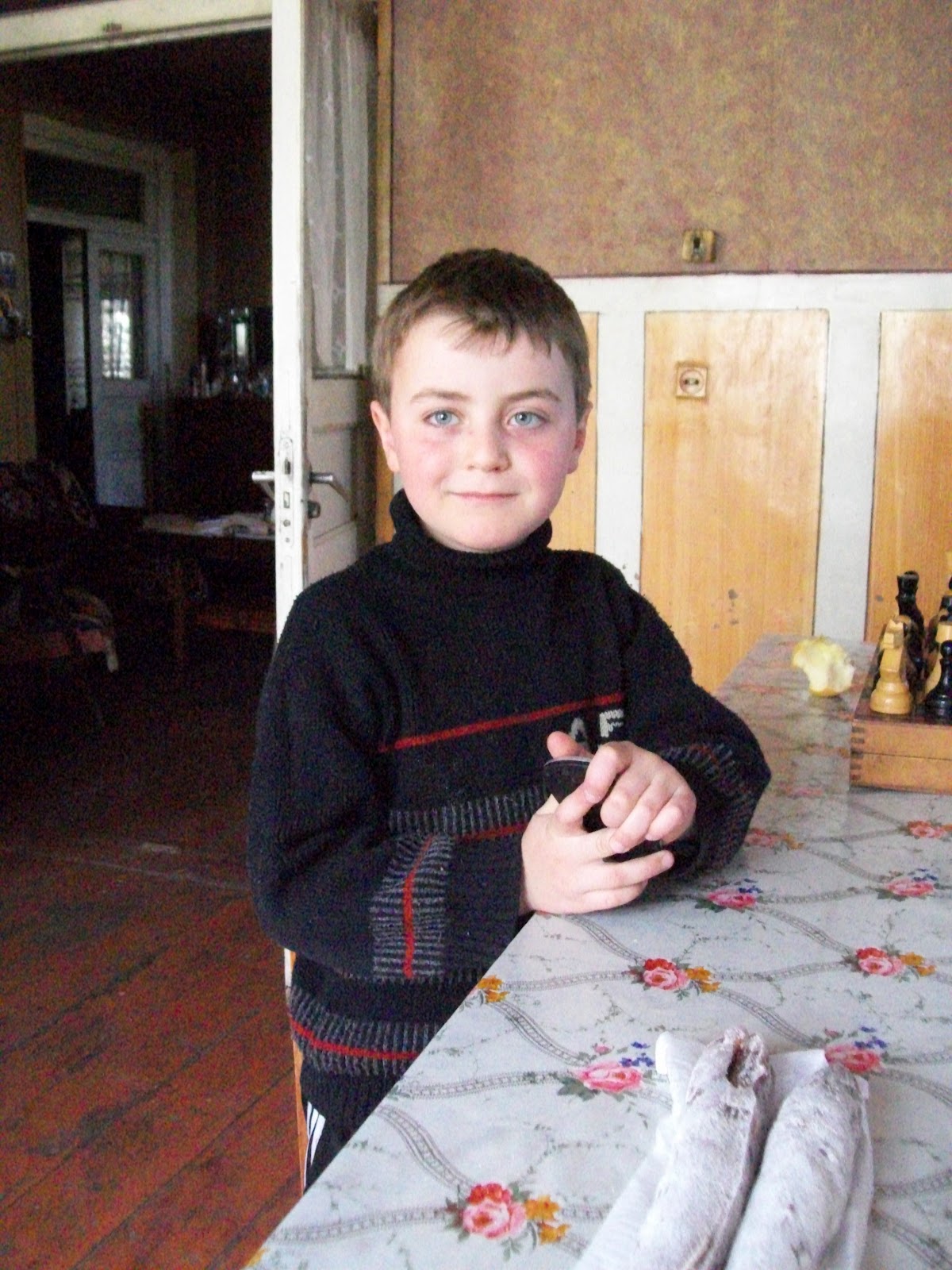 |
| The child |
 |
| The main, all-purpose room |
What I didn't anticipate was how difficult it would be to get some peace and quiet. I correctly guessed that I would be in a village. How noisy could it be? Well, the roosters are pretty loud, but I've seen them in action. They sound the alarm when a hawk is in sight, so they're not totally useless. Actually, I really enjoy the chickens. They eat organic waste, which is awesome, although they aren't too fond of carrots and cabbage. I feed them my apple cores, and in return, they provide delicious eggs. Noise-wise, it's not the roosters that bother me. I've already established that the child is extremely loud, but it's not just him. My host sister randomly bursts into song. The TV is often on, and my host family keeps the volume turned up. Neighbors constantly swing by, and they talk excitedly about who knows what. Perhaps culturally, there is just a need to fill the silence with anything: music, speech, phone calls, television, etc.
Subscribe to:
Posts (Atom)