Yesterday was Easter for Georgia's Orthodox Christians. The overwhelming majority of Georgians (84%) are Orthodox Christians; however, there are some Georgian Muslims (10%) and even some Catholics (less than 1%). Interestingly enough, there are actually Jehovah's Witnesses in Sighnaghi. The title of my post is pronounced krist'e aghsdga, and it literally means Christ has risen. This is what Georgians say instead of Happy Easter. The appropriate response is ჭეშმარიტად აღსდგა or ch'eshmarit'ad aghsdga, which means truly he has risen.
My Georgian Easter experience began on Saturday evening around 9:30pm. Grandpa drove me, my host sister, her cousin, a neighbor, and her son to Saint Nino's Monastery in Bodbe. The monastery is only a 45-minute walk from my host family's house, but I hadn't gotten around to going before then. It's very beautiful, especially inside. There are so many interesting icons and frescoes. Unfortunately, taking photos inside the church is not allowed, so you'll have travel to Georgia to see it for yourself.
The service itself was certainly different, but before I get to that, I have some random observations to share. In Georgian Orthodox churches, women must cover their heads and wearing pants is frowned upon. Georgians cross themselves top, bottom, right, and left instead of left and then right. They light candles in front of religious icons, and they kiss them. I also saw some women prostrating themselves in front of icons and touching their heads to the floor.
Things finally got going around 12:30am when a nun started chanting. With everyone packed into the little church, it was difficult to hear and see everything, but I could definitely smell body odor and beeswax candles. While the nun said her bit, a deacon (I think) started lighting candles, and then the priest started speaking. Every so often he would stop and the ladies in the choir would sing a few words and then he'd resume again. There was a little procession with a Bible and some icons, and everyone in the church filed outside afterwards and lit their beeswax candles. We circled the church twice, and then either the priest or the deacon rang the bells. After a bit we went back inside, and there was more of the same speaking and singing. The priest also swung a thurible around a bit.
At this point, my host sister and I left the church and sat outside with her cousin. Come to find out, her cousin couldn't enter the church because she had her period. I know the Bible says that makes women unclean, but come on, it's 2012. I was flabbergasted to say the least. When I got cold, I went back into the church, but I eventually went to the car and hung out with Grandpa so that I could sit and doze off around 2:00am. The service was finally over around 3:00am, and I now understand why none of the adults in the house wanted to go to church.
Monday, April 16, 2012
Monday, April 9, 2012
Peace, Quiet, Solitude, and Personal Space
If you require all of the above to function, don't come to Georgia and live with a host family if you're not willing to be rude. Right now, I am the epitome of rudeness in Georgia, and I'm okay with that.
I was on the porch with my laptop; my host sister and her laptop, which the president of Georgia personally gave to her; my host mother; my host grandmother; and the devil child. (A couple of weeks ago my host family started boarding a six-year-old boy who happens to be the worst-behaved animal in the first grade.) I had been considering moving inside for a little while, and I finally decided to retreat to my room when a guest showed up with a toddler. (The toddler has been fussing and crying for awhile now, so it was good timing.) Anyway, I'm now sitting alone in my room with the door closed, and I just blew my nose rather loudly. I'm also not wearing house slippers. How rude!
Before coming to Georgia, I was aware that Georgians are people-persons and that alone time might be hard to come by. I feel like I've handled that part rather well. Using my host sister as a translator, I was able to explain that Americans often spend time by themselves, that I would be spending time alone, and that my host family shouldn't take it to mean that I don't like them. For example, I said that after dinner in the evening at my permanent home in the States, my mum watches TV downstairs and crochets, my dad either watches TV upstairs or plays darts in the garage, and I play on the computer in my room. When I spend time alone in Georgia, I try to go for walks because it's less awkward than sequestering myself in my room, but at the moment I need some quality time with my laptop and I've gotten more than enough sun and sweat the past three days. Unfortunately, since the addition of the little monster to my host family, I've barely been spending time with anyone, but I'm not going to torture myself to avoid being rude. I just try to make the little time I do spend with my host mother and host sister meaningful.
I also knew ahead of time that the concept of personal space was nonexistent in Georgian culture. I don't consider myself a touchy-feely individual, so this has certainly been a challenge. The first couple of weeks, all of the women were pinching my cheeks, touching my hair, chucking me under the chin, and my host sister and host mother even kissed my neck. These women were all complete and utter strangers, so I really disliked all of the physical affection even though I knew that they meant well. I liked the touching even less because in Georgia there is no health education, so Georgians don't understand how important it is to wash their hands and to not cough or breathe all over you if they're sick. I approached it by asking my main co-teacher, whose English is quite good, to explain that in America people don't touch each other as much and to ask everyone to stop touching me from the neck up. No one was offended. If anything, they were amused by this cultural difference, and I haven't really had any more issues. My host mother and sister are still quite touchy, but only if I go in for the hug first
What I didn't anticipate was how difficult it would be to get some peace and quiet. I correctly guessed that I would be in a village. How noisy could it be? Well, the roosters are pretty loud, but I've seen them in action. They sound the alarm when a hawk is in sight, so they're not totally useless. Actually, I really enjoy the chickens. They eat organic waste, which is awesome, although they aren't too fond of carrots and cabbage. I feed them my apple cores, and in return, they provide delicious eggs. Noise-wise, it's not the roosters that bother me. I've already established that the child is extremely loud, but it's not just him. My host sister randomly bursts into song. The TV is often on, and my host family keeps the volume turned up. Neighbors constantly swing by, and they talk excitedly about who knows what. Perhaps culturally, there is just a need to fill the silence with anything: music, speech, phone calls, television, etc.
I was on the porch with my laptop; my host sister and her laptop, which the president of Georgia personally gave to her; my host mother; my host grandmother; and the devil child. (A couple of weeks ago my host family started boarding a six-year-old boy who happens to be the worst-behaved animal in the first grade.) I had been considering moving inside for a little while, and I finally decided to retreat to my room when a guest showed up with a toddler. (The toddler has been fussing and crying for awhile now, so it was good timing.) Anyway, I'm now sitting alone in my room with the door closed, and I just blew my nose rather loudly. I'm also not wearing house slippers. How rude!
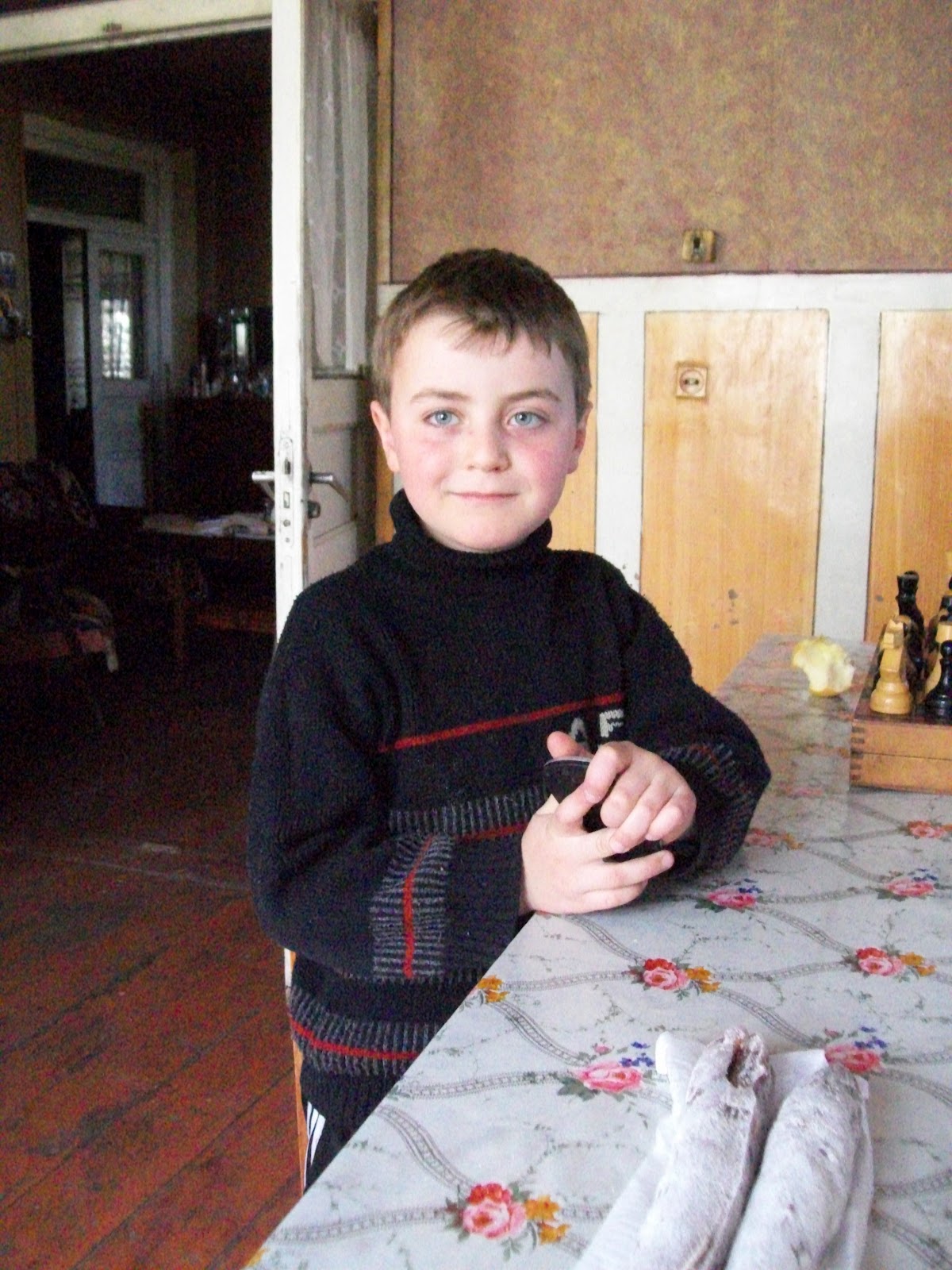
| The child |
| The main, all-purpose room |
What I didn't anticipate was how difficult it would be to get some peace and quiet. I correctly guessed that I would be in a village. How noisy could it be? Well, the roosters are pretty loud, but I've seen them in action. They sound the alarm when a hawk is in sight, so they're not totally useless. Actually, I really enjoy the chickens. They eat organic waste, which is awesome, although they aren't too fond of carrots and cabbage. I feed them my apple cores, and in return, they provide delicious eggs. Noise-wise, it's not the roosters that bother me. I've already established that the child is extremely loud, but it's not just him. My host sister randomly bursts into song. The TV is often on, and my host family keeps the volume turned up. Neighbors constantly swing by, and they talk excitedly about who knows what. Perhaps culturally, there is just a need to fill the silence with anything: music, speech, phone calls, television, etc.
Monday, April 2, 2012
Tbilisi
During orientation I didn't get the opportunity to really explore Tbilisi what with the jetlag, the long training hours, and the cold weather. Over the weekend I finally did a little sightseeing in the capitol. I'm rather lucky because my village, Nukriani, is right next to the town of Sighnaghi, and Tbilisi-bound marshrutkas leave from town at 7am, 9am, 11am, 1pm, 4pm, and 6pm. Alternatively, Sighnaghi-bound marshrutkas leave from Tbilisi's Samgori station at 9am, 11am, 1pm, 3pm, 5pm, and 6pm.
I had successfully navigated public transportation in random countries before, but this was my first time doing it alone in Georgia. I had done my research, and I knew that I needed to get off at either the Isani or Samgori stations in Tbilisi. Fortunately, Samgori was the last stop, so I wouldn't be able to miss it. From there I could either take the metro or a taxi to Freedom Square and walk to Why Not Tbilisi Legend Hostel. Tim, a veteran TLG volunteer in Sighnaghi, had kindly given me a Metro Card, so all I had to do was put some money on it and take the metro in the proper direction. I started feeling a little nervous when the marshrutka still hadn't shown up by quarter after 4. Fortunately, several teachers were leaving school just then, and they waited with me and helped me flag it down. All of my jitters subsided when Chris, a veteran TLG volunteer in my village, boarded the marshrutka a few minutes down the road. The marshrutka ride took about an hour and a half to two hours, and Chris got me as far as Freedom Square. The hostel was a short walk away, and one of the friends that I was meeting had already arrived.
That evening I went out with a group to a restaurant in Old Town, and I ate Adjarian khachapuri (აჭარული ხაჭაპური) for the first time. Khachapuri is bread filled with cheese, and it reminds me of the fiteer that I ate in Cairo. Anyway, Adjarian khachapuri has a semi-raw egg or two on top. We also ate khinkali (ხინკალი), which are dumplings filled with meat, mushrooms, or cheese. There is actually a technique to eating khinkali. You can't use silverware, and you have to bite part of the dumpling and suck out the juice. Also, you shouldn't eat the top of the dumpling, but I do anyway.
On Saturday I saw the Soviet Occupation Museum, went to the Dry Bridge Market, strolled through Old Town, hiked up to the Narikala Fortress, saw some churches, and finally had some good wine. The museum was worth seeing, especially since the lady selling the tickets gave me the student price of 1 lari even though I told her I was no longer a student. The museum's basic message was that the Soviets killed a lot of people in Georgia. The Dry Bridge Market was great! There is a bunch of nifty artwork, useless junk, souvenirs, and Soviet relics. It doesn't hold a candle to the Khan il-Khalili, but I still enjoyed it. The sellers don't harass you, which I really appreciated. Old Town was just okay. I feel like perhaps I missed the main drag, but the hike up to the fortress was awesome and awesomely tiring. After that, my Georgian acquaintance, George, showed me and my two Canadian companions some churches. Women must cover their heads in Georgian Orthodox churches--just like in mosques.
Later that evening, I finally tasted good Georgian wine! My family makes wine, but it tastes like vinegar. Before coming to Georgia, all I had read about was how delicious the wine was, but all of the wine that I had tasted prior to Saturday night had been a total letdown. There was a little shop around the corner staffed by an English-speaking Georgian, and she sold sweet, red wine. Because it's sweet, she referred to it as women's wine, but hey, that's fine with me. I like my wine to taste like juice.
I had successfully navigated public transportation in random countries before, but this was my first time doing it alone in Georgia. I had done my research, and I knew that I needed to get off at either the Isani or Samgori stations in Tbilisi. Fortunately, Samgori was the last stop, so I wouldn't be able to miss it. From there I could either take the metro or a taxi to Freedom Square and walk to Why Not Tbilisi Legend Hostel. Tim, a veteran TLG volunteer in Sighnaghi, had kindly given me a Metro Card, so all I had to do was put some money on it and take the metro in the proper direction. I started feeling a little nervous when the marshrutka still hadn't shown up by quarter after 4. Fortunately, several teachers were leaving school just then, and they waited with me and helped me flag it down. All of my jitters subsided when Chris, a veteran TLG volunteer in my village, boarded the marshrutka a few minutes down the road. The marshrutka ride took about an hour and a half to two hours, and Chris got me as far as Freedom Square. The hostel was a short walk away, and one of the friends that I was meeting had already arrived.
| Adjarian Khachapuri |
| At the Dry Bridge Market |
| View from the fortress |
| Wine shop near the hostel |
Thursday, March 22, 2012
Mikheil Saakashvili
Last Thursday Georgian President Mikheil Saakashvili openned a hospital in Tsnori, a town on the other side of Sighnaghi. A number of the older students, most of the teachers, and I attended the ceremony. I'm not really sure what I was expecting, after all I've never seen a president, but I didn't expect everything to unfold quite the way it did.
First of all, we rode there in style. I wasn't expecting an old-school bus. I also wasn't expecting the students to sing songs the entire ride there, but they did, even the older boys, especially the older boys. Now when I think of hospitals, I imagine some sort of grounds, but the whole idea of beautifying the outside of one's home or place of business hasn't really caught on here. Granted, it hadn't caught on in Egypt either, so I wasn't that surprised. Anyway, the brand new hospital was situated in a field of dust, and it was a windy day. It was a good thing I was wearing brown pants because my host mother's black pants turned gray in patches. The president arrived via helicopter and stirred up the dust even more, which was a shame because I had actually taken a shower that morning. (More about the showering situation later.) Mikheil gave a little speech, went inside the hospital, and then sped off.
The teachers kept asking me if I liked their president, but it's really hard to say when I don't know that much about him. All I could say was that it was nice of him to open a hospital. When I was in Tbilisi, I had the opportunity to spend one evening with some young Georgians, and a few of them really disliked him. I know that he's pro-United States, but that doesn't make him a good guy. Honestly, anything that I tell you about Mikheil is going to come from Wikipedia, so if you're interested, go check out his page. According to this article, the support at these events is all staged.
First of all, we rode there in style. I wasn't expecting an old-school bus. I also wasn't expecting the students to sing songs the entire ride there, but they did, even the older boys, especially the older boys. Now when I think of hospitals, I imagine some sort of grounds, but the whole idea of beautifying the outside of one's home or place of business hasn't really caught on here. Granted, it hadn't caught on in Egypt either, so I wasn't that surprised. Anyway, the brand new hospital was situated in a field of dust, and it was a windy day. It was a good thing I was wearing brown pants because my host mother's black pants turned gray in patches. The president arrived via helicopter and stirred up the dust even more, which was a shame because I had actually taken a shower that morning. (More about the showering situation later.) Mikheil gave a little speech, went inside the hospital, and then sped off.
The teachers kept asking me if I liked their president, but it's really hard to say when I don't know that much about him. All I could say was that it was nice of him to open a hospital. When I was in Tbilisi, I had the opportunity to spend one evening with some young Georgians, and a few of them really disliked him. I know that he's pro-United States, but that doesn't make him a good guy. Honestly, anything that I tell you about Mikheil is going to come from Wikipedia, so if you're interested, go check out his page. According to this article, the support at these events is all staged.
Sunday, March 18, 2012
Georgian Hospitality
Today, I attempted to take a walk, and I definitely experienced the Georgian hospitality that I had read so much about. Last week I had Khatuna, one of my co-teachers, write down the words "I am going for a walk" in Georgian so that I could inform my family if my host sister wasn't around. There's always Google Translate too. Anyway, my sister was at a dance lesson--more on Georgian dances later--and the sun was shining, so I let them know that I was going and left before they had a chance to protest or insist that someone join me.
I walked up the hill past some cows and men, and I saw one of my students, Eka, in her yard. We did the "hi, hello, how are you" routine, and I continued on my way. A couple houses up, the gym teacher at the school greeted me and beckoned me inside. I didn't really want to, but I followed her out of politeness. Little did I know that she'd roll out the red carpet. She treated me to American hot chocolate, dried grapes still on the vine, churchkhela, tatara, and peach preserves. Also, it turns out that she's the mother of one of my other students, Mary. Tatara is grape juice boiled down and thickened with flour. It looks a bit like caramel, but it's more gelatinous and less sticky. Churchkhela is made with tatara. Basically, a string of walnuts is dipped into the tatara, like dipping a candle, until it's the right thickness, and then it's dried. Voilà, churchkhela.
Visting with the gym teacher, who is also named Khatuna, was pleasant and confusing at the same time. I was so happy to get some fruit in my system, but the whole point of walking was to burn some calories. Also, Khatuna doesn't speak English, her son only speaks a little English, and my Georgian really isn't that good yet, so there was a lot of smiling and nodding. When I got up to leave, she packed a doggie bag for me so that I could bring churchkhela and tatara home to my host family, but that wasn't quite the end of our visit. She called me over into her neighbor's yard because she was baking bread, and she sent me away with some fresh tonis puri.
Speaking of puri, I watched my host mother and grandfather make some yesterday. Megi, my host mother, had a massive bowl filled with flour and salt in the kitchen yesterday morning. She added some water, mixed it up, and kneaded the dough. She let it sit for a few hours, and then we went outside to the tone, a circular oven. She rolled the dough into separate balls, and Grandpa stretched the dough and stuck it to the inside of the oven to cook. It was definitely an interesting process to watch. Maybe in the future they'll let me help although I'm rather abysmal at cooking.
| Churchkhela and tatara |
I walked up the hill past some cows and men, and I saw one of my students, Eka, in her yard. We did the "hi, hello, how are you" routine, and I continued on my way. A couple houses up, the gym teacher at the school greeted me and beckoned me inside. I didn't really want to, but I followed her out of politeness. Little did I know that she'd roll out the red carpet. She treated me to American hot chocolate, dried grapes still on the vine, churchkhela, tatara, and peach preserves. Also, it turns out that she's the mother of one of my other students, Mary. Tatara is grape juice boiled down and thickened with flour. It looks a bit like caramel, but it's more gelatinous and less sticky. Churchkhela is made with tatara. Basically, a string of walnuts is dipped into the tatara, like dipping a candle, until it's the right thickness, and then it's dried. Voilà, churchkhela.
Visting with the gym teacher, who is also named Khatuna, was pleasant and confusing at the same time. I was so happy to get some fruit in my system, but the whole point of walking was to burn some calories. Also, Khatuna doesn't speak English, her son only speaks a little English, and my Georgian really isn't that good yet, so there was a lot of smiling and nodding. When I got up to leave, she packed a doggie bag for me so that I could bring churchkhela and tatara home to my host family, but that wasn't quite the end of our visit. She called me over into her neighbor's yard because she was baking bread, and she sent me away with some fresh tonis puri.
| Tone oven |
Sunday, March 11, 2012
The Georgian Language
Georgian, or kartuli, is spoken by about 4 million people. As a point of reference, there are about 4.5 million people in the Boston metropolitan area, but in terms of size, Georgia is comparable to South Carolina. Georgian is one of those languages that developed in relative isolation, like Basque, so it isn't an Indo-European language, the most widely spoken language family. You can read more about it on the links, but basically, Georgian is in no way related to anything that we know.
![]() |
| Mkhedruli Script |
So far, I've found the language more challenging to pronounce than Arabic because it has many non-aspirated sounds, but I'm getting better. My sister likes asking me to say the word frog, which is baqkhaqkhi. Trust me, it's impossible, but it gives everyone a good laugh. I'm only just beginning to conjugate verbs, but it reminds me of Arabic in the sense that you add prefixes and sometimes suffixes to verbs.
I used this video at the end to learn to write the Georgian alphabet. It's pretty handy. The Georgian language has its own alphabet, the Mkhedruli script, which was developed between the 11th and 13th centuries. There were two earlier alphabets, but they're obsolete. I originally thought that I would be learning Cyrillic, but that didn't turn out to be the case. The modern alphabet has 33 letters, and it's phonetic, which makes my life a lot easier. There are also no capital or lowercase letters, so that's another plus. During orientation week, anyone who knew some of the alphabet was placed into the advanced Georgian class. By the end of the class, I felt pretty comfortable with the alphabet, but I don't think that we learned any more vocabulary than the other classes. We just covered the basics: Hello, How are you?, My name is Caitlin, Where is the bathroom?, etc. I have a long way to go before I'm anywhere near having a real conversation with my host mother, Bebia, and Babua.
Friday, March 9, 2012
Placement
I found out my placement the afternoon before I was supposed to go home with my host family. I am in the village of Nukriani. It's near the town of Sighnaghi in the Kakheti region. I received the following information about my family and their home: "Two-story house with indoor Western-style toilet and bathroom. Family members are grandparents, their daughter, and two grandchildren: a 15-year-old girl and a 20-year-old boy. Internet not available." TLG posted maps of each region, and I was happy that a) I found my village and b) it was near a town. I was somewhat apprehensive that I would have a similarly-aged host brother because TLG spent a decent amount of time warning women about sexual harassment and assault.
The next afternoon, all of the volunteers packed up and congregated in the hotel lobby. The members of our host families had a quick orientation, and then they joined us. The volunteers lined up on one side of the lobby; and the Georgians on the other. Tamara, our orientation leader, called out our names, and we met in the middle. I had had butterflies in my stomach all morning, and I was relieved when I finally met my host mother. We took a taxi to a marshrutka, or mini-bus, station, and while we waited for it to leave, I showed her a picture of my family to break the ice. We then used a Georgian phrasebook and lots of pointing at questions and words to communicate. She asked me all of the typical questions: How old are you? Do you have a boyfriend? Are you a Christian? Are you a Catholic? Do you have siblings? I found out that she is 39 years old and teaches justice/law/public education at the school. I also discovered that her son is a student in Tbilisi, so he doesn't live at home.
The marshrutka ride was two hours, if that, and the ride was very pleasant. I didn't want to advertise that I was a foreigner, so I didn't take pictures of the mountains, but believe me, they're breath-taking. When I arrived at the house, I met Bebia, grandmother, and Babua, grandfather. My room is actually bigger than the one I have in the States. It has a large bed, a small table, four chairs, a bureau, a wardrobe, a mirror, two windows, and a little stove. I was excited to see that my family has a modern washing machine, but I was a little stressed when I discovered that the Western toilet doesn't have a seat or toilet paper and is only for peeing. Number one and number two mean the same thing in Georgian as they do in English. There is a Turkish toilet in a little outhouse with toilet paper.
My first evening with my host family was stressful. No one spoke any English, and I was counting on being able to communicate with the son, who was in Tbilisi, and the daughter, who was absent. The family was welcoming. They made sure that I had enough to eat and that I was warm enough, but on the inside, I was freaking out. In all honesty, I cried the first night and wondered what in the world I had gotten myself into.
The next morning was a little better because I triumphed over the Turkish toilet. My biggest fear was peeing on my pants or shoes, and that didn't happen. Huzzah! Also, I finally met my host sister in the afternoon. English had never sounded sweeter, and I knew that everything was going to be okay when she put on an Eric Clapton song. We spent the whole day listening to music, watching traditional Georgian dances, and just getting to know each other. Yesterday was actually International Women's Day, so we didn't have school.
Today was even better. The school is only five minutes away, and I walked there with my host mother and my sister. The school has three floors and 205 students. I met all of the teachers, and they were very welcoming. I spent most of my time with the English teacher, but in the middle of classes Babua took me, my host mother, my sister, and three of her friends to Sighnaghi for a Magti modem. Now that I have the Internet and a few people to speak English with on a daily basis, life is good.
I'll post more about my home, toilet, village, and school later, but this was the fastest way to update everyone.
The next afternoon, all of the volunteers packed up and congregated in the hotel lobby. The members of our host families had a quick orientation, and then they joined us. The volunteers lined up on one side of the lobby; and the Georgians on the other. Tamara, our orientation leader, called out our names, and we met in the middle. I had had butterflies in my stomach all morning, and I was relieved when I finally met my host mother. We took a taxi to a marshrutka, or mini-bus, station, and while we waited for it to leave, I showed her a picture of my family to break the ice. We then used a Georgian phrasebook and lots of pointing at questions and words to communicate. She asked me all of the typical questions: How old are you? Do you have a boyfriend? Are you a Christian? Are you a Catholic? Do you have siblings? I found out that she is 39 years old and teaches justice/law/public education at the school. I also discovered that her son is a student in Tbilisi, so he doesn't live at home.
The marshrutka ride was two hours, if that, and the ride was very pleasant. I didn't want to advertise that I was a foreigner, so I didn't take pictures of the mountains, but believe me, they're breath-taking. When I arrived at the house, I met Bebia, grandmother, and Babua, grandfather. My room is actually bigger than the one I have in the States. It has a large bed, a small table, four chairs, a bureau, a wardrobe, a mirror, two windows, and a little stove. I was excited to see that my family has a modern washing machine, but I was a little stressed when I discovered that the Western toilet doesn't have a seat or toilet paper and is only for peeing. Number one and number two mean the same thing in Georgian as they do in English. There is a Turkish toilet in a little outhouse with toilet paper.
My first evening with my host family was stressful. No one spoke any English, and I was counting on being able to communicate with the son, who was in Tbilisi, and the daughter, who was absent. The family was welcoming. They made sure that I had enough to eat and that I was warm enough, but on the inside, I was freaking out. In all honesty, I cried the first night and wondered what in the world I had gotten myself into.
The next morning was a little better because I triumphed over the Turkish toilet. My biggest fear was peeing on my pants or shoes, and that didn't happen. Huzzah! Also, I finally met my host sister in the afternoon. English had never sounded sweeter, and I knew that everything was going to be okay when she put on an Eric Clapton song. We spent the whole day listening to music, watching traditional Georgian dances, and just getting to know each other. Yesterday was actually International Women's Day, so we didn't have school.
Today was even better. The school is only five minutes away, and I walked there with my host mother and my sister. The school has three floors and 205 students. I met all of the teachers, and they were very welcoming. I spent most of my time with the English teacher, but in the middle of classes Babua took me, my host mother, my sister, and three of her friends to Sighnaghi for a Magti modem. Now that I have the Internet and a few people to speak English with on a daily basis, life is good.
I'll post more about my home, toilet, village, and school later, but this was the fastest way to update everyone.
Subscribe to:
Posts (Atom)